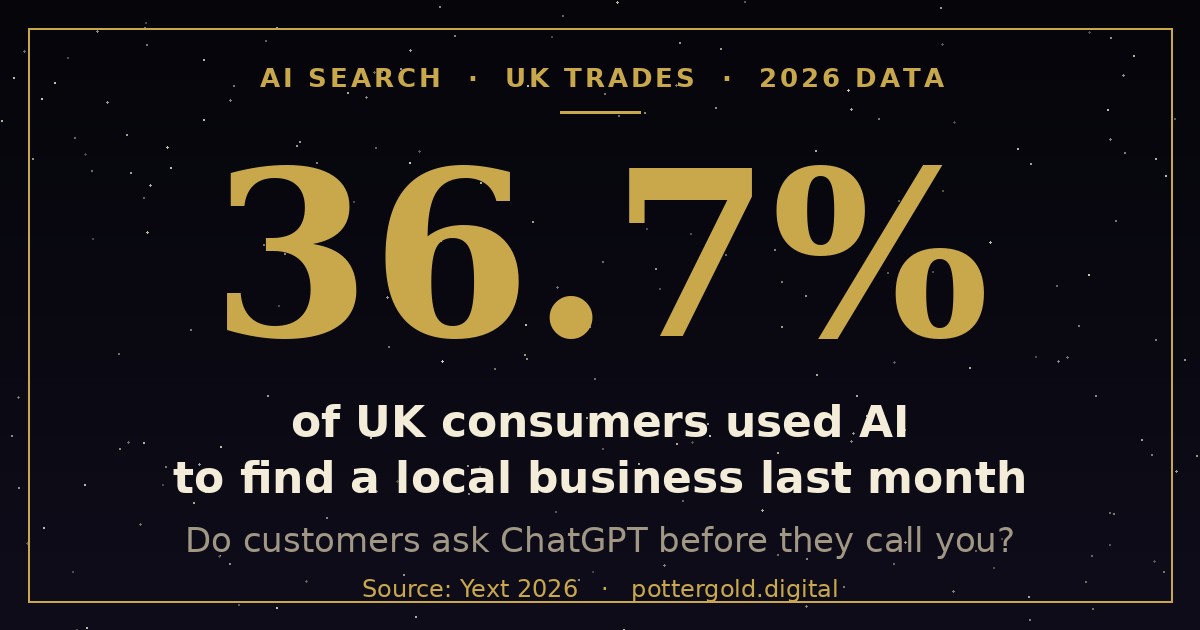
36.7% of UK consumers used AI to look for a local business in the past month.
That comes from Yext’s 2026 survey of 600 UK consumers.
Three quarters of those AI users say they use it more than they did a year ago.
So some of your next customers may ask an AI tool for a tradesperson before they open Google.
An AI tool does not show ten blue links.
It names a few firms.
If yours is not one of them, that customer never hears about you.
This guide covers what the 2026 data says, what happens after the AI names someone, and what to fix first.
It is also honest about what the numbers do not prove.
What the 2026 Data Says About AI and Local Search
Here are the three surveys that matter most.
Only one is UK data, so treat the others as a direction and not a forecast.
| Source | Who was asked | What it found |
|---|---|---|
| Yext UK, June 2026 | 600 UK consumers | 36.7% used AI for local search in the past month |
| Yext global, 2026 | 3,848 consumers worldwide | 42.7% used AI for local search in the past month |
| BrightLocal, February 2026 | 1,002 US adults | AI tools for local recommendations jumped from 6% to 45% in one year |
The UK figure sits below the global one.
UK shoppers are taking up AI a little more slowly than the global average.
The direction is the same everywhere.
In the UK, 74% of AI users rate their trust in AI local recommendations at 4 or 5 out of 5.
Globally, 28% of people tried a new local business in six months because an AI recommended it.
What the data does not prove
None of this means Google is finished.
BrightLocal found Google is still the most used source, though its share fell from 83% to 71% in a year.
Those figures come from American adults, not British ones.
These are surveys, so they show what people say they do.
They do not show how many of your enquiries come from AI today.
A fair reading is simple.
Google is still the biggest source, but AI grew faster than any other source in that survey.
You need to show up in both.
The Part Most Guides Miss: Customers Check You Before They Call
An AI recommendation is not the end of the journey.
It is the start of a background check.
Yext’s global survey found that after an AI recommendation, people take 2.6 checking steps on average.
53% search Google or Bing.
49% visit the business website directly.
28% look for reviews on Google or Yelp.
So the AI names you, and then the customer checks you.
They land on your Google profile, your website and your reviews.
If those three say different things, or say very little, you can lose the job after winning the recommendation.
BrightLocal saw the same step from the review side.
It found 54% of consumers visit a business website after reading positive reviews.
How Picky Is AI About Local Businesses?
Very picky.
SOCi studied about 350,000 business locations across 2,751 brands for its 2026 Local Visibility Index.
ChatGPT recommended 1.2% of them.
Google’s local 3-pack showed the same kind of locations 35.9% of the time on average.
That makes AI roughly 30 times more selective than the map results you already know.
Those were large American brands with many locations, not one-van trades in the UK.
The pattern still helps you.
AI names very few businesses, and the ones it names tend to have strong proof.
The locations ChatGPT recommended averaged 4.3 stars.
SOCi’s findings point to two basics: complete, accurate listings and strong reviews.
Where AI Finds Information About Your Business
SOCi also checked which sources AI uses for local answers.
Google Maps made up 32.5% of citations.
Niche directories made up 26.3%, and brand websites made up 23.1%.
Yelp made up 10.5% and Facebook made up 7.6%.
Google Maps, directories and websites together made up more than 80% of the total.
For a tradesperson, that means your Google Business Profile, your directory listings and your own website.
Those three are where the AI reads about you.
What Customers Expect Before They Choose You
97% of consumers read reviews for local businesses.
BrightLocal’s 2026 survey shows how high the bar has risen.
| What US consumers said | Share |
|---|---|
| Will not use a business with fewer than 20 reviews | 47% |
| Only look at reviews from the last three months | 74% |
| Will only use a business rated 4.5 stars or more | 31% (17% a year earlier) |
| Will only use a business rated 4 stars or more | 68% (55% a year earlier) |
| Expect the owner to reply to their review | 89% |
| Likely to use a business that replies to every review | 80% |
Those are American figures, so use them as a guide.
The bar moved a long way in one year.
A profile with 12 reviews, the newest from last spring, now looks thin to many customers.
The fix is to ask for a review after every job.
BrightLocal found 83% of people who were asked to leave a review went on to leave one.
The Five-Minute Test: Does ChatGPT Know Your Business?
You can check this yourself in five minutes.
Open ChatGPT and ask it these three questions.
Write down exactly what it says.
Question one: Who is the best [your trade] in [your town]?
Question two: Can you recommend a [your trade] in [your town] for [a job you want more of]?
Question three: What do you know about [your business name] in [your town]?
Check three things in the answers.
Were you named at all?
Are your trade, town and phone number right?
Which firms did it name instead of you?
AI answers change from person to person, so repeat the test on a second day.
If you are missing, wrong or thin in the answers, the AI does not have enough clear information about you.
That is fixable.
The firms it names are the ones you are really competing with for these customers.
Want us to run this check for you?
Our free AI Readiness audit shows what ChatGPT and Google say about your business today.
We send it within 24 hours.
Get My Free AI Readiness Audit →What to Fix First
Work through these in order.
1. Complete your Google Business Profile
Google Maps was the biggest single source in SOCi’s data at 32.5%.
Fill in every field.
Choose the right main category and add every service you offer.
Add your service areas, opening hours, phone number and real photos of your work.
Our guide to GBP categories for every UK trade shows which to pick.
2. Ask for a review after every job, and reply to each one
Send the request the same day, while the customer is pleased.
Reply to every review, good or bad, in your own words.
BrightLocal found 80% of consumers are likely to use a business that replies to all its reviews.
Our Google review system for trades shows how to do it without chasing people.
3. Make your website say who you are
Put your trade, your town and your phone number in plain text on every page.
Give each service its own page, and give each town you cover its own page.
In Yext’s global survey, 49% of people visit the website directly after an AI recommendation.
What they find there should match your Google profile exactly.
What an AI search ready website actually is explains the four basics.
4. Keep your listings identical everywhere
Use the same business name, address style and phone number on every directory.
Niche directories made up 26.3% of AI citations in SOCi’s data.
Mismatched details make a business harder to trust.
5. Let AI crawlers read your site
Some websites block AI crawlers without the owner knowing.
It takes five minutes to check your robots.txt file.
New This Month: ChatGPT Now Has Business Profiles
On 10 November 2026, OpenAI launched Businesses in ChatGPT in beta.
Eligible businesses can claim a profile, correct their details and see how often ChatGPT mentions them.
It is a beta, and eligibility depends on your business type and location.
Claiming a profile does not guarantee that ChatGPT will recommend you.
Your website, reviews and outside mentions still decide that.
We explain what is open to UK trades on our ChatGPT Business Profile page.
We check eligibility before we quote you anything.
How Potter Gold Digital Helps
Our aim is simple.
Get your business found on Google and recommended by AI.
Our Local SEO + AI Search plan is £500 a month, with a 3-month minimum term.
It covers your Google profile, reviews, website pages, listings and AI visibility.
We take one trade per town, so we never work for your direct competitor in the same place.
It starts with the free AI Readiness audit.
Sources
Yext, 2026 Consumer Search Behaviours: UK
Yext, 2026 Consumer Search Behaviors Report (global)
Yext knowledge centre: AI recommendations and verification steps
BrightLocal, Local Consumer Review Survey 2026 (1,002 US adults)
SOCi, 2026 Local Visibility Index (about 350,000 US business locations)
OpenAI, Introducing Businesses in ChatGPT, 10 November 2026
Frequently Asked Questions
Do people use ChatGPT to find local businesses in the UK?
Yes, a growing number do.
Yext’s 2026 survey found 36.7% of UK consumers used AI for local search in the past month.
Google is still the bigger source, so a tradesperson needs to show up in both.
Does ChatGPT replace Google search for finding a tradesperson?
Not yet.
BrightLocal’s 2026 US survey found Google was still the most used source at 71%, down from 83%.
AI tools rose from 6% to 45% in the same survey.
Yext’s global survey found 53% of people search Google or Bing after an AI recommendation, so people use the two together.
How do I check whether ChatGPT knows about my business?
Ask ChatGPT who the best [your trade] in [your town] is, then ask it to recommend one for a specific job.
Finally ask what it knows about your business name.
Note whether you are named, whether your details are right and which competitors appear instead.
Answers change between people and days, so repeat the test on a second day.
Our free AI Readiness audit runs this check for you and sends the results within 24 hours.
Why does ChatGPT recommend my competitor and not me?
Nobody outside OpenAI can see exactly how it chooses.
SOCi’s 2026 research found the locations ChatGPT recommended tended to have complete, accurate listings and averaged 4.3 stars.
So check your Google profile, your recent reviews, your website and your directory listings first.
If any of them is thin, out of date or different from the others, fix that before anything else.
How many Google reviews does a tradesperson need?
There is no fixed number.
BrightLocal’s 2026 US survey found 47% of consumers will not use a business with fewer than 20 reviews.
It also found 74% only look at reviews from the last three months.
So aim for at least 20 reviews, then keep a steady flow of new ones and reply to each.
Do I need GEO or AEO, or just good local SEO?
GEO and AEO are industry names for making your business easy for AI tools to find and recommend.
We call it AI search optimisation.
It builds on the same basics as local SEO: your Google profile, reviews, website and listings.
The AI part adds checks such as crawler access, schema and how AI tools describe you.
See what ChatGPT says about your business
A free AI Readiness audit checks your Google profile, reviews, listings, website and how AI tools describe you.
We send it within 24 hours.
Get My Free AI Readiness Audit →📞 01902 961078 · kp@pottergold.digital